
Les redirectes sont essentiels vers la maintenance de chaque site Web, et la gestion des redirectes devient vraiment difficile lorsque les pros du référencement traitent des sites Web contenant des millions de pages.
Exemples de situations où vous devrez peut-être mettre en œuvre des redirections à grande échelle:
- Un site de commerce électronique dispose d’un grand nombre de produits qui ne sont plus vendus.
- Les pages obsolètes des publications de nouvelles ne sont plus pertinentes ou ne manquent plus de valeur historique.
- Listing répertoires contenant des listes obsolètes.
- Des sites d’emploi où les publications expirent.
Pourquoi la redirection à l’échelle est-elle essentielle?
Il peut aider à améliorer l’expérience des utilisateurs, à consolider les classements et à économiser le budget de rampe.
Vous pourriez considérer le no-indexing, mais cela n’empêche pas Googlebot de ramper. Il gaspille le budget du budget à mesure que le nombre de pages augmente.
Du point de vue de l’expérience utilisateur, l’atterrir sur un lien obsolète est frustrant. Par exemple, si un utilisateur atterrit sur une liste de travaux obsolètes, il est préférable de les envoyer à la correspondance la plus proche pour une liste d’emplois active.
Chez Search Engine Journal, nous obtenons de nombreux 404 liens de chatbots IA en raison des hallucinations car ils inventent des URL qui n’ont jamais existé.
Nous utilisons Google Analytics 4 et Google Search Console (et parfois les journaux de serveurs) pour extraire ces 404 pages et les rediriger vers le contenu correspondant le plus proche en fonction de l’article.
Lorsque les chatbots nous citent via 404 pages et que les gens continuent de passer par des liens brisés, ce n’est pas une bonne expérience utilisateur.
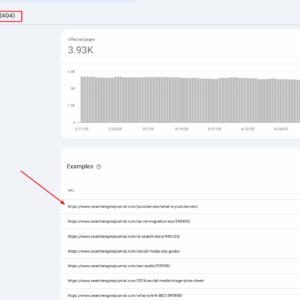
404 Rapport URL dans GSC, mai 2025
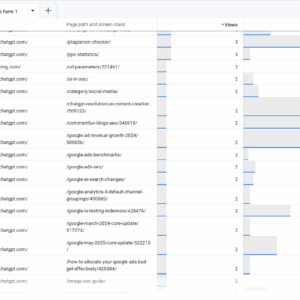
404 visites des chatbots AI, mai 2025
Préparer les candidats à redirection
Tout d’abord, lisez cet article pour apprendre à créer une base de données vectorielle de Pinecone. (Veuillez noter que dans ce cas, nous avons utilisé «primaire_category» comme clé de métadonnées contre «catégorie».)
Pour que cela fonctionne, nous supposons que tous vos vecteurs d’article sont déjà stockés dans la base de données «Article-Index-Vertex».
Préparez vos URL de redirection au format CSV comme dans ce exemple de fichier. Cela pourrait être des articles existants que vous avez décidé de tailler ou 404 à partir de vos rapports de console de recherche ou GA4.
 Exemple de fichier avec URL à rediriger (capture d’écran depuis Google Sheet, mai 2025)
Les informations facultatives «primaire_category» sont des métadonnées qui existent avec les enregistrements de poire de vos articles lorsque vous les avez créés et que vous pouvez être utilisé pour filtrer les articles de la même catégorie, améliorant davantage la précision.
Dans le cas où le titre est manquant, par exemple, dans 404 URL, le script extrait des mots de limace de l’URL et les utilisera comme entrée.
Générer des redirectes à l’aide de Google Vertex AI
Téléchargez votre Informations sur le service Google API et les renommer comme «config.json», télécharger le script ci-dessous et un exemple de fichier au même répertoire dans Jupyter Lab et exécutez-le.
import os
import time
import logging
from urllib.parse import urlparse
import re
import pandas as pd
from pandas.errors import EmptyDataError
from typing import Optional, List, Dict, Any

from google.auth import load_credentials_from_file
from google.cloud import aiplatform
from google.api_core.exceptions import GoogleAPIError

from pinecone import Pinecone, PineconeException
from vertexai.language_models import TextEmbeddingModel, TextEmbeddingInput

# Import tenacity for retry mechanism. Tenacity provides a decorator to add retry logic
# to functions, making them more robust against transient errors like network issues or API rate limits.
from tenacity import retry, wait_exponential, stop_after_attempt, retry_if_exception_type

# For clearing output in Jupyter (optional, keep if running in Jupyter).
# This is useful for interactive environments to show progress without cluttering the output.
from IPython.display import clear_output

# ─── USER CONFIGURATION ───────────────────────────────────────────────────────
# Define configurable parameters for the script. These can be easily adjusted
# without modifying the core logic.

INPUT_CSV = "redirect_candidates.csv"      # Path to the input CSV file containing URLs to be redirected.
                                           # Expected columns: "URL", "Title", "primary_category".
OUTPUT_CSV = "redirect_map.csv"            # Path to the output CSV file where the generated redirect map will be saved.
PINECONE_API_KEY = "YOUR_PINECONE_KEY"     # Your API key for Pinecone. Replace with your actual key.
PINECONE_INDEX_NAME = "article-index-vertex" # The name of the Pinecone index where article vectors are stored.
GOOGLE_CRED_PATH = "config.json"           # Path to your Google Cloud service account credentials JSON file.
EMBEDDING_MODEL_ID = "text-embedding-005"  # Identifier for the Vertex AI text embedding model to use.
TASK_TYPE = "RETRIEVAL_QUERY"              # The task type for the embedding model. Try with RETRIEVAL_DOCUMENT vs RETRIEVAL_QUERY to see the difference.
                                           # This influences how the embedding vector is generated for optimal retrieval.
CANDIDATE_FETCH_COUNT = 3    # Number of potential redirect candidates to fetch from Pinecone for each input URL.
TEST_MODE = True             # If True, the script will process only a small subset of the input data (MAX_TEST_ROWS).
                             # Useful for testing and debugging.
MAX_TEST_ROWS = 5            # Maximum number of rows to process when TEST_MODE is True.
QUERY_DELAY = 0.2            # Delay in seconds between successive API queries (to avoid hitting rate limits).
PUBLISH_YEAR_FILTER: List(int) = ()  # Optional: List of years to filter Pinecone results by 'publish_year' metadata.
                                     # If empty, no year filtering is applied.
LOG_BATCH_SIZE = 5           # Number of URLs to process before flushing the results to the output CSV.
                             # This helps in saving progress incrementally and managing memory.
MIN_SLUG_LENGTH = 3          # Minimum length for a URL slug segment to be considered meaningful for embedding.
                             # Shorter segments might be noise or less descriptive.

# Retry configuration for API calls (Vertex AI and Pinecone).
# These parameters control how the `tenacity` library retries failed API requests.
MAX_RETRIES = 5              # Maximum number of times to retry an API call before giving up.
INITIAL_RETRY_DELAY = 1      # Initial delay in seconds before the first retry.
                             # Subsequent retries will have exponentially increasing delays.

# ─── SETUP LOGGING ─────────────────────────────────────────────────────────────
# Configure the logging system to output informational messages to the console.
logging.basicConfig(
    level=logging.INFO,  # Set the logging level to INFO, meaning INFO, WARNING, ERROR, CRITICAL messages will be shown.
    format="%(asctime)s %(levelname)s %(message)s" # Define the format of log messages (timestamp, level, message).
)

# ─── INITIALIZE GOOGLE VERTEX AI ───────────────────────────────────────────────
# Set the GOOGLE_APPLICATION_CREDENTIALS environment variable to point to the
# service account key file. This allows the Google Cloud client libraries to
# authenticate automatically.
os.environ("GOOGLE_APPLICATION_CREDENTIALS") = GOOGLE_CRED_PATH
try:
    # Load credentials from the specified JSON file.
    credentials, project_id = load_credentials_from_file(GOOGLE_CRED_PATH)
    # Initialize the Vertex AI client with the project ID and credentials.
    # The location "us-central1" is specified for the AI Platform services.
    aiplatform.init(project=project_id, credentials=credentials, location="us-central1")
    logging.info("Vertex AI initialized.")
except Exception as e:
    # Log an error if Vertex AI initialization fails and re-raise the exception
    # to stop script execution, as it's a critical dependency.
    logging.error(f"Failed to initialize Vertex AI: {e}")
    raise

# Initialize the embedding model once globally.
# This is a crucial optimization for "Resource Management for Embedding Model".
# Loading the model takes time and resources; doing it once avoids repeated loading
# for every URL processed, significantly improving performance.
try:
    GLOBAL_EMBEDDING_MODEL = TextEmbeddingModel.from_pretrained(EMBEDDING_MODEL_ID)
    logging.info(f"Text Embedding Model '{EMBEDDING_MODEL_ID}' loaded.")
except Exception as e:
    # Log an error if the embedding model fails to load and re-raise.
    # The script cannot proceed without the embedding model.
    logging.error(f"Failed to load Text Embedding Model: {e}")
    raise

# ─── INITIALIZE PINECONE ──────────────────────────────────────────────────────
# Initialize the Pinecone client and connect to the specified index.
try:
    pinecone = Pinecone(api_key=PINECONE_API_KEY)
    index = pinecone.Index(PINECONE_INDEX_NAME)
    logging.info(f"Connected to Pinecone index '{PINECONE_INDEX_NAME}'.")
except PineconeException as e:
    # Log an error if Pinecone initialization fails and re-raise.
    # Pinecone is a critical dependency for finding redirect candidates.
    logging.error(f"Pinecone init error: {e}")
    raise

# ─── HELPERS ───────────────────────────────────────────────────────────────────
def canonical_url(url: str) -> str:
    """
    Converts a given URL into its canonical form by:
    1. Stripping query strings (e.g., `?param=value`) and URL fragments (e.g., `#section`).
    2. Handling URL-encoded fragment markers (`%23`).
    3. Preserving the trailing slash if it was present in the original URL's path.
       This ensures consistency with the original site's URL structure.

    Args:
        url (str): The input URL.

    Returns:
        str: The canonicalized URL.
    """
    # Remove query parameters and URL fragments.
    temp = url.split('?', 1)(0).split('#', 1)(0)
    # Check for URL-encoded fragment markers and remove them.
    enc_idx = temp.lower().find('%23')
    if enc_idx != -1:
        temp = temp(:enc_idx)
    # Determine if the original URL path ended with a trailing slash.
    has_slash = urlparse(temp).path.endswith('/')
    # Remove any trailing slash temporarily for consistent processing.
    temp = temp.rstrip('/')
    # Re-add the trailing slash if it was originally present.
    return temp + ('/' if has_slash else '')


def slug_from_url(url: str) -> str:
    """
    Extracts and joins meaningful, non-numeric path segments from a canonical URL
    to form a "slug" string. This slug can be used as text for embedding when
    a URL's title is not available.

    Args:
        url (str): The input URL.

    Returns:
        str: A hyphen-separated string of relevant slug parts.
    """
    clean = canonical_url(url) # Get the canonical version of the URL.
    path = urlparse(clean).path # Extract the path component of the URL.
    segments = (seg for seg in path.split('/') if seg) # Split path into segments and remove empty ones.

    # Filter segments based on criteria:
    # - Not purely numeric (e.g., '123' is excluded).
    # - Length is greater than or equal to MIN_SLUG_LENGTH.
    # - Contains at least one alphanumeric character (to exclude purely special character segments).
    parts = (seg for seg in segments
             if not seg.isdigit()
             and len(seg) >= MIN_SLUG_LENGTH
             and re.search(r'(A-Za-z0-9)', seg))
    return '-'.join(parts) # Join the filtered parts with hyphens.

# ─── EMBEDDING GENERATION FUNCTION ─────────────────────────────────────────────
# Apply retry mechanism for GoogleAPIError. This makes the embedding generation
# more resilient to transient issues like network problems or Vertex AI rate limits.
@retry(
    wait=wait_exponential(multiplier=INITIAL_RETRY_DELAY, min=1, max=10), # Exponential backoff for retries.
    stop=stop_after_attempt(MAX_RETRIES), # Stop retrying after a maximum number of attempts.
    retry=retry_if_exception_type(GoogleAPIError), # Only retry if a GoogleAPIError occurs.
    reraise=True # Re-raise the exception if all retries fail, allowing the calling function to handle it.
)
def generate_embedding(text: str) -> Optional(List(float)):
    """
    Generates a vector embedding for the given text using the globally initialized
    Vertex AI Text Embedding Model. Includes retry logic for API calls.

    Args:
        text (str): The input text (e.g., URL title or slug) to embed.

    Returns:
        Optional(List(float)): A list of floats representing the embedding vector,
                               or None if the input text is empty/whitespace or
                               if an unexpected error occurs after retries.
    """
    if not text or not text.strip():
        # If the text is empty or only whitespace, no embedding can be generated.
        return None
    try:
        # Use the globally initialized model to get embeddings.
        # This is the "Resource Management for Embedding Model" optimization.
        inp = TextEmbeddingInput(text, task_type=TASK_TYPE)
        vectors = GLOBAL_EMBEDDING_MODEL.get_embeddings((inp), output_dimensionality=768)
        return vectors(0).values # Return the embedding vector (list of floats).
    except GoogleAPIError as e:
        # Log a warning if a GoogleAPIError occurs, then re-raise to trigger the `tenacity` retry mechanism.
        logging.warning(f"Vertex AI error during embedding generation (retrying): {e}")
        raise # The `reraise=True` in the decorator will catch this and retry.
    except Exception as e:
        # Catch any other unexpected exceptions during embedding generation.
        logging.error(f"Unexpected error generating embedding: {e}")
        return None # Return None for non-retryable or final failed attempts.

# ─── MAIN PROCESSING FUNCTION ─────────────────────────────────────────────────
def build_redirect_map(
    input_csv: str,
    output_csv: str,
    fetch_count: int,
    test_mode: bool
):
    """
    Builds a redirect map by processing URLs from an input CSV, generating
    embeddings, querying Pinecone for similar articles, and identifying
    suitable redirect candidates.

    Args:
        input_csv (str): Path to the input CSV file.
        output_csv (str): Path to the output CSV file for the redirect map.
        fetch_count (int): Number of candidates to fetch from Pinecone.
        test_mode (bool): If True, process only a limited number of rows.
    """
    # Read the input CSV file into a Pandas DataFrame.
    df = pd.read_csv(input_csv)
    required = {"URL", "Title", "primary_category"}
    # Validate that all required columns are present in the DataFrame.
    if not required.issubset(df.columns):
        raise ValueError(f"Input CSV must have columns: {required}")

    # Create a set of canonicalized input URLs for efficient lookup.
    # This is used to prevent an input URL from redirecting to itself or another input URL,
    # which could create redirect loops or redirect to a page that is also being redirected.
    input_urls = set(df("URL").map(canonical_url))

    start_idx = 0
    # Implement resume functionality: if the output CSV already exists,
    # try to find the last processed URL and resume from the next row.
    if os.path.exists(output_csv):
        try:
            prev = pd.read_csv(output_csv)
        except EmptyDataError:
            # Handle case where the output CSV exists but is empty.
            prev = pd.DataFrame()
        if not prev.empty:
            # Get the last URL that was processed and written to the output file.
            last = prev("URL").iloc(-1)
            # Find the index of this last URL in the original input DataFrame.
            idxs = df.index(df("URL").map(canonical_url) == last).tolist()
            if idxs:
                # Set the starting index for processing to the row after the last processed URL.
                start_idx = idxs(0) + 1
                logging.info(f"Resuming from row {start_idx} after {last}.")

    # Determine the range of rows to process based on test_mode.
    if test_mode:
        end_idx = min(start_idx + MAX_TEST_ROWS, len(df))
        df_proc = df.iloc(start_idx:end_idx) # Select a slice of the DataFrame for testing.
        logging.info(f"Test mode: processing rows {start_idx} to {end_idx-1}.")
    else:
        df_proc = df.iloc(start_idx:) # Process all remaining rows.
        logging.info(f"Processing rows {start_idx} to {len(df)-1}.")

    total = len(df_proc) # Total number of URLs to process in this run.
    processed = 0        # Counter for successfully processed URLs.
    batch: List(Dict(str, Any)) = () # List to store results before flushing to CSV.

    # Iterate over each row (URL) in the DataFrame slice to be processed.
    for _, row in df_proc.iterrows():
        raw_url = row("URL") # Original URL from the input CSV.
        url = canonical_url(raw_url) # Canonicalized version of the URL.
        # Get title and category, handling potential missing values by defaulting to empty strings.
        title = row("Title") if isinstance(row("Title"), str) else ""
        category = row("primary_category") if isinstance(row("primary_category"), str) else ""

        # Determine the text to use for generating the embedding.
        # Prioritize the 'Title' if available, otherwise use a slug derived from the URL.
        if title.strip():
            text = title
        else:
            slug = slug_from_url(raw_url)
            if not slug:
                # If no meaningful slug can be extracted, skip this URL.
                logging.info(f"Skipping {raw_url}: insufficient slug context for embedding.")
                continue
            text = slug.replace('-', ' ') # Prepare slug for embedding by replacing hyphens with spaces.

        # Attempt to generate the embedding for the chosen text.
        # This call is wrapped in a try-except block to catch final failures after retries.
        try:
            embedding = generate_embedding(text)
        except GoogleAPIError as e:
            # If embedding generation fails even after retries, log the error and skip this URL.
            logging.error(f"Failed to generate embedding for {raw_url} after {MAX_RETRIES} retries: {e}")
            continue # Move to the next URL.

        if not embedding:
            # If `generate_embedding` returned None (e.g., empty text or unexpected error), skip.
            logging.info(f"Skipping {raw_url}: no embedding generated.")
            continue

        # Build metadata filter for Pinecone query.
        # This helps narrow down search results to more relevant candidates (e.g., by category or publish year).
        filt: Dict(str, Any) = {}
        if category:
            # Split category string by comma and strip whitespace for multiple categories.
            cats = (c.strip() for c in category.split(",") if c.strip())
            if cats:
                filt("primary_category") = {"$in": cats} # Filter by categories present in Pinecone metadata.
        if PUBLISH_YEAR_FILTER:
            filt("publish_year") = {"$in": PUBLISH_YEAR_FILTER} # Filter by specified publish years.
        filt("id") = {"$ne": url} # Exclude the current URL itself from the search results to prevent self-redirects.

        # Define a nested function for Pinecone query with retry mechanism.
        # This ensures that Pinecone queries are also robust against transient errors.
        @retry(
            wait=wait_exponential(multiplier=INITIAL_RETRY_DELAY, min=1, max=10),
            stop=stop_after_attempt(MAX_RETRIES),
            retry=retry_if_exception_type(PineconeException), # Only retry if a PineconeException occurs.
            reraise=True # Re-raise the exception if all retries fail.
        )
        def query_pinecone_with_retry(embedding_vector, top_k_count, pinecone_filter):
            """
            Performs a Pinecone index query with retry logic.
            """
            return index.query(
                vector=embedding_vector,
                top_k=top_k_count,
                include_values=False, # We don't need the actual vector values in the response.
                include_metadata=False, # We don't need the metadata in the response for this logic.
                filter=pinecone_filter # Apply the constructed metadata filter.
            )

        # Attempt to query Pinecone for redirect candidates.
        try:
            res = query_pinecone_with_retry(embedding, fetch_count, filt)
        except PineconeException as e:
            # If Pinecone query fails after retries, log the error and skip this URL.
            logging.error(f"Failed to query Pinecone for {raw_url} after {MAX_RETRIES} retries: {e}")
            continue # Move to the next URL.

        candidate = None # Initialize redirect candidate to None.
        score = None     # Initialize relevance score to None.

        # Iterate through the Pinecone query results (matches) to find a suitable candidate.
        for m in res.get("matches", ()):
            cid = m.get("id") # Get the ID (URL) of the matched document in Pinecone.
            # A candidate is suitable if:
            # 1. It exists (cid is not None).
            # 2. It's not the original URL itself (to prevent self-redirects).
            # 3. It's not another URL from the input_urls set (to prevent redirecting to a page that's also being redirected).
            if cid and cid != url and cid not in input_urls:
                candidate = cid # Assign the first valid candidate found.
                score = m.get("score") # Get the relevance score of this candidate.
                break # Stop after finding the first suitable candidate (Pinecone returns by relevance).

        # Append the results for the current URL to the batch.
        batch.append({"URL": url, "Redirect Candidate": candidate, "Relevance Score": score})
        processed += 1 # Increment the counter for processed URLs.
        msg = f"Mapped {url} → {candidate}"
        if score is not None:
            msg += f" ({score:.4f})" # Add score to log message if available.
        logging.info(msg) # Log the mapping result.

        # Periodically flush the batch results to the output CSV.
        if processed % LOG_BATCH_SIZE == 0:
            out_df = pd.DataFrame(batch) # Convert the current batch to a DataFrame.
            # Determine file mode: 'a' (append) if file exists, 'w' (write) if new.
            mode="a" if os.path.exists(output_csv) else 'w'
            # Determine if header should be written (only for new files).
            header = not os.path.exists(output_csv)
            # Write the batch to the CSV.
            out_df.to_csv(output_csv, mode=mode, header=header, index=False)
            batch.clear() # Clear the batch after writing to free memory.
            if not test_mode:
                # clear_output(wait=True) # Uncomment if running in Jupyter and want to clear output
                clear_output(wait=True)
                print(f"Progress: {processed} / {total}") # Print progress update.

        time.sleep(QUERY_DELAY) # Pause for a short delay to avoid overwhelming APIs.

    # After the loop, write any remaining items in the batch to the output CSV.
    if batch:
        out_df = pd.DataFrame(batch)
        mode="a" if os.path.exists(output_csv) else 'w'
        header = not os.path.exists(output_csv)
        out_df.to_csv(output_csv, mode=mode, header=header, index=False)

    logging.info(f"Completed. Total processed: {processed}") # Log completion message.

if __name__ == "__main__":
    # This block ensures that build_redirect_map is called only when the script is executed directly.
    # It passes the user-defined configuration parameters to the main function.
    build_redirect_map(INPUT_CSV, OUTPUT_CSV, CANDIDATE_FETCH_COUNT, TEST_MODE)
Vous verrez un test exécuté avec seulement cinq enregistrements, et vous verrez un nouveau fichier appelé «redirect_map.csv», qui contient des suggestions de redirection.
Une fois que vous vous assurez que le code fonctionne bien, vous pouvez définir le TEST_MODE booléen à vrai False et exécutez le script pour toutes vos URL.
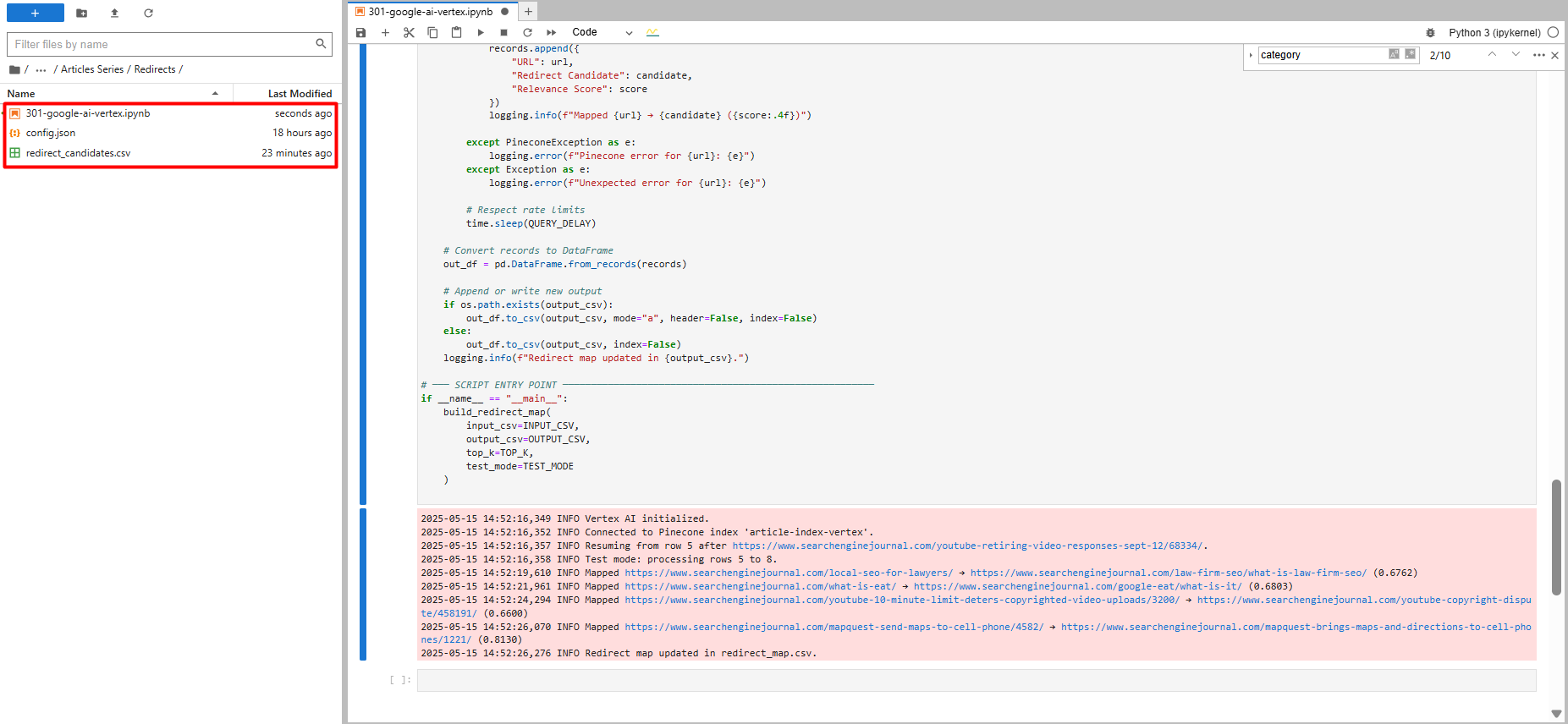 Test exécuté avec seulement cinq enregistrements (image de l’auteur, mai 2025)
Si le code s’arrête et que vous reprenez, il reprend là où il s’était arrêté. Il vérifie également chaque redirection qu’il trouve par rapport au fichier CSV.
Ce chèque empêche la sélection d’une URL de la base de données sur la liste élaguée. La sélection d’une telle URL pourrait provoquer une boucle de redirection infinie.
Pour nos URL d’échantillon, la sortie est indiqué ci-dessous.
 Rediriger les candidats à l’aide de Google Vertex Ai Task Type Retieval_Query (image de l’auteur, mai 2025)
Nous pouvons maintenant prendre cette carte de redirection et l’importer dans notre gestionnaire de redirection dans le système de gestion de contenu (CMS), et c’est tout!
Vous pouvez voir comment il a réussi à correspondre à l’article de presse 2013 obsolète «YouTube Retirant des réponses vidéo le 12 septembre» à l’article de presse plus récent et très pertinent «YouTube adopte la fonctionnalité de Tiktok – Répondre aux commentaires avec une vidéo».
Également pour «/ what-est-eat /», il a trouvé une correspondance avec «/ google-eat / what-is-it /», qui est une correspondance 100% parfaite.
Ce n’est pas seulement dû à la puissance de la qualité de Google Vertex LLM, mais aussi le résultat du choix des bons paramètres.
Lorsque j’utilise «Retrieval_Document» comme type de tâche lors de la génération de vecteur de requête incorporcements pour l’article de presse YouTube montré ci-dessus, il correspond à «YouTube élargit les publications de la communauté à plus de créateurs», qui est toujours pertinent mais pas aussi bon que l’autre.
Pour «/ What-Is-Eat /», il correspond à l’article «/ Reimagining-eeat-to-drive-plus-plus-bien-vente et à la recherche-visibilité / 545790 /», qui n’est pas aussi bon que «/ google-eat / what-is-it /».
Si vous vouliez trouver des correspondances de redirection à partir de votre pool d’articles nouveaux, vous pouvez interroger Pinecone avec un filtre de métadonnées supplémentaires, «Publish_year», si vous avez ce champ de métadonnées dans vos enregistrements PineCone, que je recommande fortement de créer.
Dans le code, c’est un PUBLISH_YEAR_FILTER variable.
Si vous avez publish_year Métadonnées, vous pouvez définir les années comme valeurs de tableau, et elle tirera des articles publiés au cours des années spécifiées.
Générer des redirectes en utilisant les intérêts du texte d’Openai
Faisons la même tâche avec le modèle «Text-Embedding-ADA-002» d’OpenAI. Le but est de montrer la différence de sortie de Google Vertex AI.
Créez simplement un nouveau fichier de carnet dans le même répertoire, copiez et collez ce code et exécutez-le.
import os
import time
import logging
from urllib.parse import urlparse
import re

import pandas as pd
from pandas.errors import EmptyDataError
from typing import Optional, List, Dict, Any

from openai import OpenAI
from pinecone import Pinecone, PineconeException

# Import tenacity for retry mechanism. Tenacity provides a decorator to add retry logic
# to functions, making them more robust against transient errors like network issues or API rate limits.
from tenacity import retry, wait_exponential, stop_after_attempt, retry_if_exception_type

# For clearing output in Jupyter (optional, keep if running in Jupyter)
from IPython.display import clear_output

# ─── USER CONFIGURATION ───────────────────────────────────────────────────────
# Define configurable parameters for the script. These can be easily adjusted
# without modifying the core logic.

INPUT_CSV = "redirect_candidates.csv"       # Path to the input CSV file containing URLs to be redirected.
                                            # Expected columns: "URL", "Title", "primary_category".
OUTPUT_CSV = "redirect_map.csv"             # Path to the output CSV file where the generated redirect map will be saved.
PINECONE_API_KEY = "YOUR_PINECONE_API_KEY"      # Your API key for Pinecone. Replace with your actual key.
PINECONE_INDEX_NAME = "article-index-ada"   # The name of the Pinecone index where article vectors are stored.
OPENAI_API_KEY = "YOUR_OPENAI_API_KEY"    # Your API key for OpenAI. Replace with your actual key.
OPENAI_EMBEDDING_MODEL_ID = "text-embedding-ada-002" # Identifier for the OpenAI text embedding model to use.
CANDIDATE_FETCH_COUNT = 3    # Number of potential redirect candidates to fetch from Pinecone for each input URL.
TEST_MODE = True             # If True, the script will process only a small subset of the input data (MAX_TEST_ROWS).
                             # Useful for testing and debugging.
MAX_TEST_ROWS = 5            # Maximum number of rows to process when TEST_MODE is True.
QUERY_DELAY = 0.2            # Delay in seconds between successive API queries (to avoid hitting rate limits).
PUBLISH_YEAR_FILTER: List(int) = ()  # Optional: List of years to filter Pinecone results by 'publish_year' metadata eg. (2024,2025).
                                     # If empty, no year filtering is applied.
LOG_BATCH_SIZE = 5           # Number of URLs to process before flushing the results to the output CSV.
                             # This helps in saving progress incrementally and managing memory.
MIN_SLUG_LENGTH = 3          # Minimum length for a URL slug segment to be considered meaningful for embedding.
                             # Shorter segments might be noise or less descriptive.

# Retry configuration for API calls (OpenAI and Pinecone).
# These parameters control how the `tenacity` library retries failed API requests.
MAX_RETRIES = 5              # Maximum number of times to retry an API call before giving up.
INITIAL_RETRY_DELAY = 1      # Initial delay in seconds before the first retry.
                             # Subsequent retries will have exponentially increasing delays.

# ─── SETUP LOGGING ─────────────────────────────────────────────────────────────
# Configure the logging system to output informational messages to the console.
logging.basicConfig(
    level=logging.INFO,  # Set the logging level to INFO, meaning INFO, WARNING, ERROR, CRITICAL messages will be shown.
    format="%(asctime)s %(levelname)s %(message)s" # Define the format of log messages (timestamp, level, message).
)

# ─── INITIALIZE OPENAI CLIENT & PINECONE ───────────────────────────────────────
# Initialize the OpenAI client once globally. This handles resource management efficiently
# as the client object manages connections and authentication.
client = OpenAI(api_key=OPENAI_API_KEY)
try:
    # Initialize the Pinecone client and connect to the specified index.
    pinecone = Pinecone(api_key=PINECONE_API_KEY)
    index = pinecone.Index(PINECONE_INDEX_NAME)
    logging.info(f"Connected to Pinecone index '{PINECONE_INDEX_NAME}'.")
except PineconeException as e:
    # Log an error if Pinecone initialization fails and re-raise.
    # Pinecone is a critical dependency for finding redirect candidates.
    logging.error(f"Pinecone init error: {e}")
    raise

# ─── HELPERS ───────────────────────────────────────────────────────────────────
def canonical_url(url: str) -> str:
    """
    Converts a given URL into its canonical form by:
    1. Stripping query strings (e.g., `?param=value`) and URL fragments (e.g., `#section`).
    2. Handling URL-encoded fragment markers (`%23`).
    3. Preserving the trailing slash if it was present in the original URL's path.
       This ensures consistency with the original site's URL structure.

    Args:
        url (str): The input URL.

    Returns:
        str: The canonicalized URL.
    """
    # Remove query parameters and URL fragments.
    temp = url.split('?', 1)(0)
    temp = temp.split('#', 1)(0)
    # Check for URL-encoded fragment markers and remove them.
    enc_idx = temp.lower().find('%23')
    if enc_idx != -1:
        temp = temp(:enc_idx)
    # Determine if the original URL path ended with a trailing slash.
    preserve_slash = temp.endswith('/')
    # Strip trailing slash if not originally present.
    if not preserve_slash:
        temp = temp.rstrip('/')
    return temp


def slug_from_url(url: str) -> str:
    """
    Extracts and joins meaningful, non-numeric path segments from a canonical URL
    to form a "slug" string. This slug can be used as text for embedding when
    a URL's title is not available.

    Args:
        url (str): The input URL.

    Returns:
        str: A hyphen-separated string of relevant slug parts.
    """
    clean = canonical_url(url) # Get the canonical version of the URL.
    path = urlparse(clean).path # Extract the path component of the URL.
    segments = (seg for seg in path.split('/') if seg) # Split path into segments and remove empty ones.

    # Filter segments based on criteria:
    # - Not purely numeric (e.g., '123' is excluded).
    # - Length is greater than or equal to MIN_SLUG_LENGTH.
    # - Contains at least one alphanumeric character (to exclude purely special character segments).
    parts = (seg for seg in segments
             if not seg.isdigit()
             and len(seg) >= MIN_SLUG_LENGTH
             and re.search(r'(A-Za-z0-9)', seg))
    return '-'.join(parts) # Join the filtered parts with hyphens.

# ─── EMBEDDING GENERATION FUNCTION ─────────────────────────────────────────────
# Apply retry mechanism for OpenAI API errors. This makes the embedding generation
# more resilient to transient issues like network problems or API rate limits.
@retry(
    wait=wait_exponential(multiplier=INITIAL_RETRY_DELAY, min=1, max=10), # Exponential backoff for retries.
    stop=stop_after_attempt(MAX_RETRIES), # Stop retrying after a maximum number of attempts.
    retry=retry_if_exception_type(Exception), # Retry on any Exception from OpenAI client (can be refined to openai.APIError if desired).
    reraise=True # Re-raise the exception if all retries fail, allowing the calling function to handle it.
)
def generate_embedding(text: str) -> Optional(List(float)):
    """
    Generate a vector embedding for the given text using OpenAI's text-embedding-ada-002
    via the globally initialized OpenAI client. Includes retry logic for API calls.

    Args:
        text (str): The input text (e.g., URL title or slug) to embed.

    Returns:
        Optional(List(float)): A list of floats representing the embedding vector,
                               or None if the input text is empty/whitespace or
                               if an unexpected error occurs after retries.
    """
    if not text or not text.strip():
        # If the text is empty or only whitespace, no embedding can be generated.
        return None
    try:
        resp = client.embeddings.create( # Use the globally initialized OpenAI client to get embeddings.
            model=OPENAI_EMBEDDING_MODEL_ID,
            input=text
        )
        return resp.data(0).embedding # Return the embedding vector (list of floats).
    except Exception as e:
        # Log a warning if an OpenAI error occurs, then re-raise to trigger the `tenacity` retry mechanism.
        logging.warning(f"OpenAI embedding error (retrying): {e}")
        raise # The `reraise=True` in the decorator will catch this and retry.

# ─── MAIN PROCESSING FUNCTION ─────────────────────────────────────────────────
def build_redirect_map(
    input_csv: str,
    output_csv: str,
    fetch_count: int,
    test_mode: bool
):
    """
    Builds a redirect map by processing URLs from an input CSV, generating
    embeddings, querying Pinecone for similar articles, and identifying
    suitable redirect candidates.

    Args:
        input_csv (str): Path to the input CSV file.
        output_csv (str): Path to the output CSV file for the redirect map.
        fetch_count (int): Number of candidates to fetch from Pinecone.
        test_mode (bool): If True, process only a limited number of rows.
    """
    # Read the input CSV file into a Pandas DataFrame.
    df = pd.read_csv(input_csv)
    required = {"URL", "Title", "primary_category"}
    # Validate that all required columns are present in the DataFrame.
    if not required.issubset(df.columns):
        raise ValueError(f"Input CSV must have columns: {required}")

    # Create a set of canonicalized input URLs for efficient lookup.
    # This is used to prevent an input URL from redirecting to itself or another input URL,
    # which could create redirect loops or redirect to a page that is also being redirected.
    input_urls = set(df("URL").map(canonical_url))

    start_idx = 0
    # Implement resume functionality: if the output CSV already exists,
    # try to find the last processed URL and resume from the next row.
    if os.path.exists(output_csv):
        try:
            prev = pd.read_csv(output_csv)
        except EmptyDataError:
            # Handle case where the output CSV exists but is empty.
            prev = pd.DataFrame()
        if not prev.empty:
            # Get the last URL that was processed and written to the output file.
            last = prev("URL").iloc(-1)
            # Find the index of this last URL in the original input DataFrame.
            idxs = df.index(df("URL").map(canonical_url) == last).tolist()
            if idxs:
                # Set the starting index for processing to the row after the last processed URL.
                start_idx = idxs(0) + 1
                logging.info(f"Resuming from row {start_idx} after {last}.")

    # Determine the range of rows to process based on test_mode.
    if test_mode:
        end_idx = min(start_idx + MAX_TEST_ROWS, len(df))
        df_proc = df.iloc(start_idx:end_idx) # Select a slice of the DataFrame for testing.
        logging.info(f"Test mode: processing rows {start_idx} to {end_idx-1}.")
    else:
        df_proc = df.iloc(start_idx:) # Process all remaining rows.
        logging.info(f"Processing rows {start_idx} to {len(df)-1}.")

    total = len(df_proc) # Total number of URLs to process in this run.
    processed = 0        # Counter for successfully processed URLs.
    batch: List(Dict(str, Any)) = () # List to store results before flushing to CSV.

    # Iterate over each row (URL) in the DataFrame slice to be processed.
    for _, row in df_proc.iterrows():
        raw_url = row("URL") # Original URL from the input CSV.
        url = canonical_url(raw_url) # Canonicalized version of the URL.
        # Get title and category, handling potential missing values by defaulting to empty strings.
        title = row("Title") if isinstance(row("Title"), str) else ""
        category = row("primary_category") if isinstance(row("primary_category"), str) else ""

        # Determine the text to use for generating the embedding.
        # Prioritize the 'Title' if available, otherwise use a slug derived from the URL.
        if title.strip():
            text = title
        else:
            raw_slug = slug_from_url(raw_url)
            if not raw_slug or len(raw_slug)
Tandis que la qualité du sortir Peut être considéré comme satisfaisant, il est en deçà de la qualité observée avec Google Vertex AI.
Ci-dessous dans le tableau, vous pouvez voir la différence de qualité de sortie.
| URL | Google Vertex | AI ouvert |
| / What-est-il / | / google-eat / what-is-it / | / 5-Things-you-can-do-right-now-to-improve-your-eat-for-google / 408423 / |
| / local-seo-for-lawyers / | / Law-Firm-Seo / What-Is-Law-Firm-Seo / | / juridique-seo-conférence-exclusivement pour les avocats-SPA / 528149 / |
En ce qui concerne le référencement, même si Google Vertex AI est trois fois plus cher que le modèle d’OpenAI, je préfère utiliser Vertex.
La qualité des résultats est nettement plus élevée. Bien que vous puissiez encourir un coût plus élevé par unité de texte traité, vous bénéficiez de la qualité de sortie supérieure, ce qui permet directement à un temps précieux sur l’examen et la validation des résultats.
D’après mon expérience, il en coûte environ 0,04 $ pour traiter 20 000 URL à l’aide de Google Vertex AI.
Bien que l’on dit qu’il soit plus cher, il est toujours ridiculement bon marché, et vous ne devriez pas vous inquiéter si vous avez affaire à des tâches impliquant quelques milliers d’URL.
Dans le cas du traitement de 1 million d’URL, le prix prévu serait d’environ 2 $.
Si vous voulez toujours une méthode gratuite, utilisez des modèles Bert et Llama en étreignant le visage pour générer des incorporations vectorielles sans payer de frais par appel.
Le coût réel provient de la puissance de calcul nécessaire pour exécuter les modèles, et vous devez générer des incorporations vectorielles de tous vos articles dans PineCone ou toute autre base de données vectorielle en utilisant ces modèles si vous interrogez à l’aide de vecteurs générés à partir de Bert ou Llama.
En résumé: AI est votre puissant allié
L’IA vous permet d’étendre vos efforts de référencement ou de marketing et d’automatiser les tâches les plus fastidieuses.
Cela ne remplace pas votre expertise. Il est conçu pour améliorer vos compétences et vous équiper pour faire face à des défis avec une plus grande capacité, ce qui rend le processus plus attrayant et plus amusant.
La maîtrise de ces outils est essentielle au succès. Je suis passionné par l’écriture sur ce sujet pour aider les débutants à apprendre et à me sentir inspirés.
Au fur et à mesure que nous avançons dans cette série, nous explorerons comment utiliser Google Vertex AI pour construire un plugin WordPress de liaison interne.
Plus de ressources:
Image en vedette: Bestforbest / Shutterstock
Commentaires